
Author

admin

Browsing

African Discovery Group (OTC:AFDG) (“AFDG” or the “Company”) has entered into a term sheet to acquire the Butembo Copper exploration license in the Democratic Republic of Congo (DRC) by acquiring 100% of the shares of SOCIETE GRABIN MINING SAS (the “Transaction”). The Butembo Copper project is a greenfield exploration project located in the North Kivu province of the Democratic Republic of Congo. 40km south of the provincial capital of Beni. The project is located 33km west of the Ugandan border with verified road and rail access to the port of Mombasa.

The area is generally underexplored relative to the well-known copper belts of the Katanga copper belt to the south – however the Mesoproterozoic Kibalian greenstone belt is known for its tungsten-tin-gold occurrences, and it hosts the well-known Kilembe Mine nearby which has produced substantial quantities of both copper and cobalt

According to Rio Tinto, African deposits make up eight out of the 10 highest grade deposits discovered since 1990. The recent discovery of the Butembo copper deposit has underscored the need for further exploration work in areas peripheral to the Katanga Copper Belt.It is important to note that the artisanal pits initially targeted and extracted alluvial gold in the surficial gravels that overly the schists hosting the copper mineralization.The implication is that Butembo is prospective for both gold and copper.

The Butembo discovery is a near surface high-grade copper oxidized ore with measured grades of up to 18% with depth and lateral extension potential of over 5km along strike. The project is located at the base of the Ruwenzori mountains and borders Virunga National Park. There is extensive artisanal activity for both copper and gold and by extension a thriving small scale minerals industry exists in Butembo going back years. Regolith clay samples to the north have tested positively for copper – this is interpreted as a positive indicator of a northern extension to Butembo.

The artisanal and first phase exploration pits around the flood plain of the Talehya River, which runs through the concession, have been tested over an initial 500m of strike length – and the results have been positive with one of these analyses reporting the 18% Cu mentioned above as well as 16.3% in another exploration pit.

The deposit is in the vicinity of the historic Kilembe copper mine (4 million tons) across the border in Uganda whose sulphide mineralization occurs within biotite schists thought to have formed by hydrothermal fluids during early tectonic cycles that were trapped in structurally favorable impermeable locations. This offers a unique insight into the potential geological controls of the Butembo deposit. Mineralization is structurally controlled, occurring along northeast-trending shear zones and folds that facilitated hydrothermal fluid flow. The primary ore minerals include chalcopyrite, pyrite, and linnaeite, forming massive sulfide lenses and disseminated zones.

The Butembo deposit holds a strategically advantageous location, benefiting from proximity to regional infrastructure, which includes electrical power being available within reach of the project boundary. The site is located close to the Ugandan border, offering access to the East African transport corridor. This includes road and rail connections through Uganda to the port of Mombasa, Kenya—providing a viable export route for future development.

The combination of surface high-grade mineralization, artisanal activity, infrastructure access, and strategic location positions the Butembo Copper Project as a high-potential target for early-stage exploration and resource delineation.

Source
This post appeared first on investingnews.com

Perth, Australia (ABN Newswire) – Locksley Resources Ltd (ASX:LKY,OTC:LKYRF) (FRA:X5L) (OTCMKTS:LKYRF) is pleased to advise that a senior Locksley team has completed a visit to Rice University in Houston, Texas, to formally evaluate the Company’s research collaboration with Rice.

Highlights

– Given increased industry interest in DeepSolv(TM), the Company has requested the expansion & acceleration of the Rice technology program

– The expansion would include the following components:

o Testing of multiple antimony feedstocks at different processing stages, direct ore, post DMS and high-grade concentrates

o Testing of antimony feedstock from multiple sources including the Mojave Project, EV Resources and additional other 3rd party samples

– Meetings held with Professor Pulickel Ajayan, Rice Executive Vice President for Research, and Technology Transfer Office

– Dedicated project workshop with the Ajayan research team to discuss technical programs

– Locksley in discussions with an additional mining group regarding the opportunity of evaluation the DeepSolv(TM) technology

– Locksley is focused upon providing Antimony processing independence to the USA and the opportunity presented by the $1.5bn+ domestic market

During the visit, the Locksley team met with Professor Pulickel Ajayan and members of his laboratory, senior Rice administrators including the Executive Vice President for Research and the Office of Technology Transfer and representatives from Rice Public Affairs. These discussions were followed by a dedicated project workshop with the Ajayan group, providing the foundation for the joint technical program under the collaboration.

The work program, formally launched through this visit, will focus on two parallel thrusts:

1. The development of DeepSolv(TM) product, for the extraction and refining of antimony feedstocks

2. The evaluation of antimony-based materials for advanced energy storage applications

As previously announced, Locksley has secured an agreement with EV Resources for the supply of external antimony ore, which will be incorporated alongside feedstock from the Mojave Project to support the development of DeepSolv(TM). In addition, DeepSolv(TM) continues to gain industry momentum, with discussions now underway with an additional potential user for the treatment of antimony ore. Given the growing industry interest in DeepSolv(TM) the Company is actively evaluating options to expand and accelerate the Rice technology program.

Locksley views the Rice partnership as a cornerstone of its U.S. strategy, providing access to world class expertise and positioning the Company to advance both upstream and downstream opportunities in antimony and rare earths.

Locksley’s Chairman Patrick Burke, commented:

‘This visit marks an important milestone in Locksley’s mine-to-market strategy to onshore the supply of antimony and rare earths into the United States. By formally commencing our collaboration with Rice University and incorporating additional ore supply secured through our agreement with EV Resources, we have laid the foundation for a practical and accelerated testwork program. These initiatives position Locksley at the centre of developing a secure domestic supply chain, aligned with U.S. government priorities. We look forward to working closely with Professor Ajayan and his team as we move rapidly toward delivering tangible results.’

*To view images and figures, please visit:
https://abnnewswire.net/lnk/U3C84R75

About Locksley Resources Limited:

Locksley Resources Limited (ASX:LKY,OTC:LKYRF) (FRA:X5L) (OTCMKTS:LKYRF) is an ASX listed explorer focused on critical minerals in the United States of America. The Company is actively advancing exploration across two key assets: the Mojave Project in California, targeting rare earth elements (REEs) and antimony. Locksley Resources aims to generate shareholder value through strategic exploration, discovery and development in this highly prospective mineral region.

Mojave Project

Located in the Mojave Desert, California, the Mojave Project comprises over 250 claims across two contiguous prospect areas, namely, the North Block/Northeast Block and the El Campo Prospect. The North Block directly abuts claims held by MP Materials, while El Campo lies along strike of the Mountain Pass Mine and is enveloped by MP Materials’ claims, highlighting the strong geological continuity and exploration potential of the project area.

In addition to rare earths, the Mojave Project hosts the historic ‘Desert Antimony Mine’, which last operated in 1937. Despite the United States currently having no domestic antimony production, demand for the metal remains high due to its essential role in defense systems, semiconductors, and metal alloys. With significant surface sample results, the Desert Mine prospect represents one of the highest-grade known antimony occurrences in the U.S.

Locksley’s North American position is further strengthened by rising geopolitical urgency to diversify supply chains away from China, the global leader in both REE & antimony production. With its maiden drilling program planned, the Mojave Project is uniquely positioned to align with U.S. strategic objectives around critical mineral independence and economic security.

Tottenham Project

Locksley’s Australian portfolio comprises the advanced Tottenham Copper-Gold Project in New South Wales, focused on VMS-style mineralisation

Source:
Locksley Resources Limited

Contact:
Locksley Resources Limited
T: +61 8 9481 0389
E: info@locksleyresources.com.au

News Provided by ABN Newswire via QuoteMedia

This post appeared first on investingnews.com

A judicial consensus is forming against climate lawfare, but the U.S. Supreme Court must still end environmental extortion of American energy. In two landmark cases, the court will soon have the opportunity to reassert the federal government’s authority over questions of national energy and environmental policy. 

Environmental groups believe that energy use increases global temperatures, causes sea levels to rise and creates more destructive weather. Their campaign to curtail energy has taken many forms — including asking the Environmental Protection Agency (EPA) to block pipelines and the Interior Department to deny oil and gas leases — but it met a roadblock with the 2024 election and the Trump administration’s subsequent blizzard of executive orders lifting overregulation.  

Rather than pursue their interests in Congress or before the electorate, environmental extremists have now allied with bankrupt cities and trial lawyers to use the courts to shake down the energy industry. Blue cities and states have filed tort suits in state courts to extract money for allegedly causing weather-related costs in their jurisdictions. 

The Supreme Court will soon decide whether to take up one of those cases, Boulder County v. Suncor Energy, following a ruling this year from the Colorado Supreme Court that allowed the county’s case to move forward in state court. Borrowing theories of liability from tobacco and opioid litigation, Boulder alleges that energy companies sold their products without disclosing climate risks. Such claims plainly intrude on federal authority over interstate pollution. 

Other climate cases are still progressing in lower state courts. In Hawaii, summary judgment motions are pending in a case seeking damages for rising sea levels. Hawaii’s highest court allowed this litigation to move forward in 2023 with Justice Todd Eddins issuing a remarkable concurrence, declaring that litigation would proceed under the ‘Aloha Spirit,’ regardless of federal precedent.  

In Rhode Island, the state judge presiding over a similar lawsuit against the energy industry compared it to developing nations devastated by natural disasters, citing Kenya, Tanzania and the Seychelles. The suggestion that Rhode Island has suffered comparable ‘severe destruction’ is telling: judges are inflating rhetoric to justify climate claims, not grounding them in law.  

Meanwhile, other states are effectively trying to replace federal authority over environmental policy. In Louisiana, plaintiffs obtained a $750 million judgment (potentially over $1 billion with interest) against Chevron for coastal erosion that they claimed was caused by oil extraction during World War II. Those companies had been under federal contracts to supply aviation fuel for the war effort. Yet eight decades later, Louisiana claims it can punish those practices retroactively. 

The energy firms sought to move the case to federal court because of its genesis in work for the federal government. But a divided 5th U.S. Circuit Court of Appeals panel refused to allow it. As Judge Andrew Oldham rightly noted in dissent, crude oil extraction plainly ‘relates to’ war production. If states can sue private businesses for their wartime work generations later, future cooperation with the federal government will be chilled, raising the costs of national defense. This coming term, the Supreme Court will review the Fifth Circuit’s decision. 

Despite some disappointing rulings from activist judges, a growing number of state courts are beginning to resist such frivolous claims. A Maryland judge rejected Baltimore’s lawsuit that alleged fossil fuels caused sea rises that have harmed the city; the Maryland Supreme Court will hear the appeal later in October. A South Carolina court dismissed Charleston’s similar claims, which blue city officials will almost certainly appeal as well. Likewise, nearly identical state and municipal lawsuits have been similarly dismissed in Pennsylvania, New York, Delaware and New Jersey. 

Notwithstanding some recent wins, climate lawfare is like Hydra — new cases are constantly being brought. Even if higher courts ultimately overturn them, simply forcing the industry to defend against these suits imposes enormous litigation costs. That alone is a victory for environmental radicals. At this stage, the Supreme Court must act to reaffirm federal authority over national energy and environmental policy.  

If climate change is producing harmful effects nationwide, then the nation should decide how to address it. As the U.S. Court of Appeals ruled in a 2021 case rejecting New York City’s lawsuit against Chevron, ‘the question before us is whether a nuisance suit seeking to recover damages for the harms caused by global greenhouse gas emissions may proceed under New York law. Our answer is simple: no.’ However, they frame their aims, blue cities and states are trying to set nationwide climate policy through litigation — violating federal law and tort principles. 

As the country decides how to respond to climate change, those choices — including the possibility of not acting — must have nationwide legitimacy. Courts cannot allow a handful of blue jurisdictions, aided by trial lawyers and environmental activists, to dictate those decisions for the rest of America. 

This post appeared first on FOX NEWS

House Republicans’ campaign arm is going after Democrats hours after the federal government entered a shutdown at midnight on Wednesday.

A new National Republican Congressional Committee (NRCC) ad being rolled out in 42 battleground districts is aimed at putting pressure on Democratic lawmakers to accept the GOP’s plan and end the shutdown.

‘Democrats refused to fund the government. So now military troops, police and Border Patrol lose their paychecks. Because of Democrats, veterans, farmers, small businesses lose critical funding. Disaster relief — cut off,’ a voiceover states.

‘Democrats are grinding America to a halt in order to give illegal immigrants free healthcare. Tell Democrats: Stop the shutdown.’

The ad buy came at a four-figure price tag, according to an NRCC spokesperson.

It’s being rolled out in 25 districts represented by Democrats and 17 held by Republicans.

The federal government shut down overnight after Democrats and Republicans in the Senate failed to reach a spending agreement in time for the end of fiscal year (FY) 2025 on Sept. 30.

A short-term extension of FY 2025 funding, aimed at giving Congress more time to reach a longer-term deal, failed to advance in the Senate on Tuesday evening.

The measure, aimed at keeping the government open through Nov. 21, passed the House mainly along party lines earlier this month.

Democrats were angered at being sidelined in the spending negotiations, and by the GOP bill’s exclusion of enhanced COVID-19-era Obamacare subsidies. Those subsidies, passed in 2021 under President Joe Biden, are set to expire by the end of 2025 without congressional action.

Republicans have signaled that they will not budge from their measure, citing Democrats’ past support for similar bills aimed at averting shutdowns.

‘Out of touch Democrats shut down the government to bankroll handouts for illegal immigrants and appease their radical base. Voters won’t forget who betrayed them, and the NRCC will make sure Democrats pay the price,’ NRCC spokesman Mike Marinella told Fox News Digital.

President Donald Trump and his administration have wide discretion over what changes occur during a shutdown.

However, it’s likely that thousands of government employees get furloughed, while others are made to work without paychecks until funding is reinstituted. A host of federal agencies and services could also be shuttered.

Some federal workers could lose their jobs permanently as well, with Office of Management and Budget Director Russ Vought issuing guidance earlier this month warning offices to consider plans for mass layoffs in the event of a shutdown.

This post appeared first on FOX NEWS

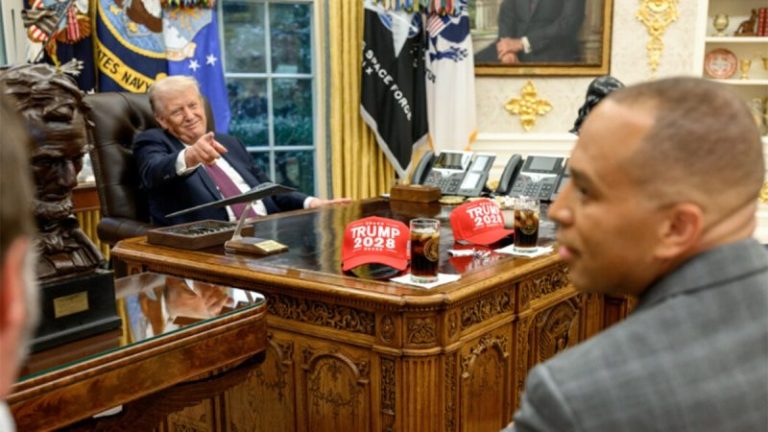
President Donald Trump shared photos on Truth Social on Tuesday showing red ‘Trump 2028’ hats strategically displayed on the Resolute Desk during an Oval Office meeting with Democrat leaders Monday in hopes of fending off a government shutdown.

Trump’s post came late Tuesday, hours before Washington grappled with its first shutdown since 2018-19. 

‘The Trump administration wants a straightforward and clean CR [continuing resolution] to continue funding the government – the exact same proposal that Democrats supported just 6 months ago, 13 times under the Biden Administration,’ White House spokeswoman Abigail Jackson told Fox News Digital. 

‘But radical Democrats are shutting the government down because they want a nearly $1.5 trillion wish list of demands, including free health care for illegal aliens. The Democrat’s radical agenda was rejected by the American people less than a year ago at the ballot box, now they’re shutting down the government and hold the American people hostage over it.’

Vice President JD Vance warned, ‘I think we’re headed to a shutdown’ after Monday’s meeting. 

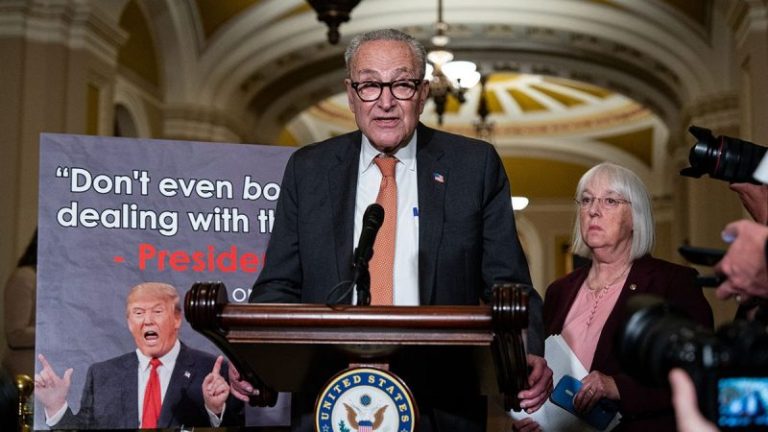
Senate Minority Leader Chuck Schumer, D-N.Y., said at the time the sides ‘have very large differences.’ 

Late Tuesday, the Senate failed a last-ditch vote on extending funding and barreled toward a shutdown as the clock struck midnight on Oct. 1.

Trump posted the photos late Tuesday, a few hours before the shutdown was slated to begin. 

His campaign has sold ‘Trump 2028’ hats since earlier this year.

Democrat leaders downplayed the stunt. 

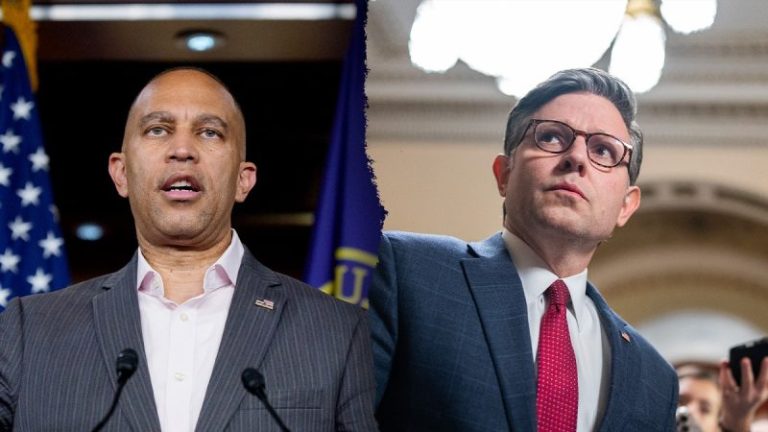
Schumer said Trump ‘can avoid a shutdown if he chooses to,’ while House Minority Leader Hakeem Jeffries, D-N.Y., added, ‘we will not back down’ in defending healthcare and spending priorities.’

Trump presided over a 35-day government shutdown in 2018–19, the longest in American history, during his first term in office.

This post appeared first on FOX NEWS

Senate Democrats again blocked Republicans’ short-term funding extension Tuesday afternoon, further increasing the odds of a partial government shutdown and thousands of federal workers going without paychecks.

Democratic lawmakers in the upper chamber, led by Senate Minority Leader Chuck Schumer, D-N.Y., banded together to vote against the GOP’s continuing resolution (CR), a move that marked the second time Democrats impeded the legislation’s progress this month.

Congress has until midnight Wednesday to pass a CR or else the government will shut down. However, the possibility of that happening became increasingly unlikely throughout the day as Republicans and Democrats huddled behind closed doors in separate meetings hours before the vote. 

The bill, which was passed by the House GOP earlier this month, failed on a largely party-line vote, 55-45. Sen. Rand Paul, R-Ky., was the lone Republican to vote against the bill, while Sens. John Fetterman, D-Pa., Catherine Cortez Masto, D-Nev., and Angus King, I-Maine, crossed the aisle to vote for the funding extension.

Democrats also tried to advance their own counter-proposal, but that bill was similarly blocked by Senate Republicans.

There is still time to avert a partial shutdown, but the window is closing fast. If Schumer and Thune are unable to find a path forward, it would mark the third shutdown under President Donald Trump.

When asked if he believed a shutdown was inevitable, Trump said, ‘Nothing is inevitable.’ 

‘But I would say it’s probably likely, because they want to give healthcare to illegal immigrants, which will destroy healthcare for everybody else in our country,’ he told reporters in the Oval Office. ‘And I didn’t see them bend even a little bit when I said we can’t do that.’ 

Shortly after the vote, however, the Office of Management and Budget released a memo that the appropriations for Fiscal Year 2025 would run out at 11:59 p.m. on Tuesday, making a shutdown official. 

‘It is unclear how long Democrats will maintain their untenable posture, making the duration of the shutdown difficult to predict,’ the memo read. 

Republicans want to pass a ‘clean’ short-term extension until Nov. 21 that would give appropriators time to finish spending bills, while Democrats want to extend expiring Obamacare premium subsidies, among multiple other demands.

But the chances of a deal materializing, particularly one that meets Democrats’ demands, are slim. Both Senate leaders traded barbs throughout the day, first on the Senate floor and then in back-to-back press conferences. 

Thune panned Democrats’ push for an extension to the expiring tax credits, which aren’t set to sunset until the end of this year, as well as their other demands to repeal the healthcare portion of Trump’s ‘big, beautiful bill’ and clawback canceled funding for NPR and PBS. 

Republicans argue that reversing the cuts from Trump’s megabill and undoing the public broadcasting rescission would amount to $1.5 trillion in spending tacked onto their short-term funding extension. 

‘These are things that they’re demanding as part of their so-called negotiation,’ Thune said. ‘Ladies and gentlemen, there isn’t anything here to negotiate.’

Schumer, however, countered that the decision to shut the government down was ‘in their court’ and charged that Democrats were working to solve the GOP’s ‘healthcare crisis.’

Still, despite scoring a meeting in the Oval Office with Trump and congressional Republican leaders, in addition to public guarantees from Thune and Republicans that Obamacare tax credits could be discussed after a shutdown was averted, Schumer demanded that Democrats be cut in on negotiations to craft a bipartisan bill. 

Earlier in the day, the top Senate Democrat commandeered a floor chart from Thune that showed how many times Democrats supported CRs under former President Joe Biden. He said that each time, Republicans were involved in the process. 

‘As leader, I sat down with the Republicans every one of those years and created a bipartisan bill. Their bill is partisan. They call it clean. We call it partisan. It has no Democratic input,’ Schumer said. ‘Thune never talked to me.’ 

This post appeared first on FOX NEWS

The Interior Department announced Tuesday it is testing autonomous lawnmowers on the National Mall in Washington, D.C., in an effort by the Trump administration to use artificial intelligence to ‘boost operational efficiency.’

In an order obtained by Fox News Digital, Interior Secretary Doug Burgum said AI will ‘drive smarter decision-making, boost operational efficiency, and better deliver on our core mission of advancing American energy dominance, protecting our natural resources, partnering with Tribal Nations, and enhancing internal services.’ 

The Interior Department is working with a private company, the name of which was not shared, to develop its AI technologies for use by the agency. 

Video shared with Fox News Digital shows a demonstration of the AI-controlled lawnmowers on the National Mall, each carrying an American flag. Visitors scanned a QR code on the technology to view a map tracking their progress.

In the video, Jeff Gowen, division manager of the National Park Service’s Technical Services Division, said the new machines will ‘allow us to get more work done with the same amount of people.’

Gowen added that six AI-controlled lawnmowers are being tested at six national parks with a grant provided by the National Park Foundation. 

‘Wild time to be alive,’ he said.

In his order, Burgum said AI will strengthen relationships with state and tribal lands while pushing federal agencies to adopt AI faster and more responsibly.

‘To fully unlock the potential of AI, we must scale intelligently, govern responsibly, and enable our workforce to lead with confidence and clarity,’ he said. ‘As AI becomes more accessible to the DOI workforce, it offers real opportunities to modernize how we serve, strengthening coordination with stakeholders, including State and Tribal partners, across the Nation’s lands.’

In addition to the lawnmowers, Burgum said the Interior Department is already using AI for wildfire response and environmental reviews.

‘AI is reshaping how industries operate and government must not be left behind, and must adapt to private sector standards,’ he said in the order.

‘AI offers a strategic advantage across all facets of the Department’s mission, enabling an advanced workforce with well-trained employees to strengthen domestic resource development and operational efficiency, allowing for the best management of public lands,’ he added. ‘AI adoption shall be pursued in ways that strengthen Interior’s ability to serve the American people through safe, responsible, and outcome-oriented innovation.’

The lawnmowers come after the Trump administration released its ‘America’s AI Action Plan’ in July, a plan aimed at securing U.S. dominance in AI. The plan highlights AI’s role in economic competitiveness and national security.

‘Winning the AI race will usher in a new golden age of human flourishing, economic competitiveness, and national security for the American people,’ the White House said.

This post appeared first on FOX NEWS

Charlie Javice, the founder of a startup company that sought to dramatically improve how students apply for financial aid, was sentenced Monday to more than seven years in prison for cheating JPMorgan Chase out of $175 million by greatly exaggerating how many students it served.

Javice, 33, was sentenced in Manhattan federal court for her March conviction by Judge Alvin K. Hellerstein, who said she committed “a large fraud” by duping the bank giant in the summer of 2021. She made false records that made it seem the company, called Frank, had over 4 million customers when it had fewer than 300,000, Hellerstein found.

The judge said Javice had assembled a “very powerful list” of her charitable acts, which included organizing soup kitchens for the homeless when she was 7 years old and designing career programs for formerly incarcerated women.

In court papers, defense lawyers noted that Javice has faced extraordinary public scrutiny, reputational destruction and professional exile, “making her a household name” in the same way Elizabeth Holmes became synonymous with her blood-testing company, Theranos.

Defense attorney Ronald Sullivan told Hellerstein that his client was very different from Holmes because what she created actually worked, unlike Holmes, “who did not have a real company” and whose product “in fact endangered patients.”

In seeking a 12-year prison sentence for Javice, prosecutors cited a 2022 text Javice sent to a colleague in which she called it “ridiculous” that Holmes got over 11 years in prison.

Hellerstein largely dismissed arguments that he should be lenient because the acquisition pitted “a 28-year-old versus 300 investment bankers from the largest bank in the world,” as Sullivan put it.

Still, the judge criticized the bank, saying “they have a lot to blame themselves” after failing to do adequate due diligence. He quickly added, though, that he was “punishing her conduct and not JPMorgan’s stupidity.”

Sullivan said the bank rushed its negotiations because it feared another bank would acquire Frank first.

A prosecutor, Micah Fergenson, though, said JPMorgan “didn’t get a functioning business” in exchange for its investment. “They acquired a crime scene.”

Fergenson said Javice was driven by greed when she saw that she could pocket $29 million from the sale of her company.

“Ms. Javice had it dangling in front of her and she lied to get it,” he said.

Given a chance to speak, Javice said she was “haunted that my failure has transformed something meaningful into something infamous.” She said she “made a choice that I will spend my entire life regretting.”

Javice, sometimes speaking through tears, apologized and sought forgiveness from “all the people touched or tarnished by my actions,” including JPMorgan shareholders, Frank employees and investors, along with her family.

Javice, who lives in Florida, has been free on $2 million bail since her 2023 arrest.

At trial, Javice, a graduate of the University of Pennsylvania’s Wharton School of Business, was convicted of conspiracy, bank fraud and wire fraud charges. Her lawyers had argued that JPMorgan went after Javice because it had buyer’s remorse.

In her mid-20s, Javice founded Frank, a company with software that promised to simplify the arduous process of filling out the Free Application for Federal Student Aid, a complex government form used by students to apply for aid for college or graduate school.

Frank’s backers included venture capitalist Michael Eisenberg. The company said its offering, akin to online tax preparation software, could help students maximize financial aid while making the application process less painful.

The company promoted itself as a way for financially needy students to obtain more aid faster, in return for a few hundred dollars in fees. Javice appeared regularly on cable news programs to boost Frank’s profile, once appearing on Forbes’ “30 Under 30” list before JPMorgan bought the startup in 2021.

Javice was among a number of young tech executives who vaulted to fame with supposedly disruptive or transformative companies, only to see them collapse amid questions about whether they had engaged in puffery and fraud while dealing with investors.

In their pre-sentence submission, prosecutors wrote that they were requesting a lengthy prison sentence to send a message that fraud in the sale of startup companies is “no less blameworthy than other types of fraud and will be punished accordingly.”

Prosecutors added that the message was “desperately needed” because of “an alarming trend of founders and executives of small startup companies engaging in fraud, including making misrepresentations about their companies’ core products or services, in order to make their companies attractive targets for investors and/or buyers.”

This post appeared first on NBC NEWS

Electronic Arts, maker of video games like “Madden NFL,” “Battlefield,” and “The Sims,” is being acquired for $52.5 billion in what could become the largest-ever buyout funded by private-equity firms.

The private equity firm Silver Lake Partners, Saudi Arabia’s sovereign wealth fund PIF, and Affinity Partners will pay EA’s stockholders $210 per share. Affinity Partners is run by President Donald Trump’s son-in-law, Jared Kushner.

PIF, which was already the largest insider stakeholder in Electronic Arts, will be rolling over its existing 9.9% stake in the company.

The commitment to the massive deal is inline with recent activity by Saudi Arabia’s sovereign wealth fund, wrote Andrew Marok of Raymond James.

“The Saudi PIF has been a very active player in the video gaming market since 2022, taking minority stakes in most scaled public video gaming publishers, and also outright purchases of companies like ESL, FACEIT, and Scopely,” he wrote. “The PIF has made its intentions to scale its gaming arm, Savvy Gaming Group, clear, and the EA deal would represent the biggest such move to date by some distance.”

Electronic Arts would be taken private and its headquarters will remain in Redwood City, California.

The total value of the deal eclipses the $32 billion price paid to take Texas utility TXU private in 2007.

If the transaction closes as anticipated, it will end EA’s 36-year history as a publicly traded company that began with its shares ending its first day of trading at a split-adjusted 52 cents.

The IPO came seven years after EA was founded by former Apple employee William “Trip” Hawkins, who began playing analog versions of baseball and football made by “Strat-O-Matic” as a teenager during the 1960s.

CEO Andrew Wilson has led the company since 2013 and he will remain in that role, the firms said Monday.

“Electronic Arts is an extraordinary company with a world-class management team and a bold vision for the future,” said Kushner, who serves as CEO of Affinity Partners. “I’ve admired their ability to create iconic, lasting experiences, and as someone who grew up playing their games — and now enjoys them with his kids — I couldn’t be more excited about what’s ahead.”

This marks the second high-profile deal involving Silver Lake and a technology company with a legion of loyal fans in recent weeks. Silver Lake is also part of a newly formed joint venture spearheaded by Oracle involved in a deal to take over the U.S. oversight of TikTok’s social video platform, although all the details of that complex transaction haven’t been divulged yet.

Silver Lake has also previously bought out two other well-known technology companies, the now-defunct video calling service Skype in a $1.9 billion deal completed in 2009, and a $24.9 billion buyout of personal computer maker Dell in 2013. After Dell restructured its operations as a private company, it returned to the stock market with publicly traded shares in 2018.

By going private, EA will be able to reprogram its operations without being subjected to the investment pressures and scrutiny that sometimes compel publicly held companies to make short-sighted decisions aimed at meeting quarterly financial targets. Although its video games still have a fervent following, EA’s annual revenues have been stagnant during the past three fiscal years, hovering from $7.4 billion to $7.6 billion.

Meanwhile, one of its biggest rivals Activision Blizzard was snapped up by technology powerhouse Microsoft for nearly $69 billion in 2023, while the competition from mobile video game makers such as Epic Games has intensified.

After being taken private, formerly public companies often undergo extensive cost-cutting that includes layoffs, although there has been no indication that will be the case with EA. After jettisoning about 5% of its workforce in 2024, EA ended March with 14,500 employees and then laid off several hundred people in May.

The deal is expected to close in the first quarter of 2027. It still needs approval from EA shareholders.

EA’s stock rose more than 5% before the opening bell.

This post appeared first on NBC NEWS

The owners of nearly 200,000 BMWs should park their vehicles outside because they risk catching fire while parked or being driven, the National Highway Traffic Safety Administration announced Friday.

The vehicle models affected include 2019-22 Z4; 2019-21 330I; 2020-22 X3; 2020-22 X4; 2020-22 530I; 2021-22 430I standard and convertible; 2022 230I; and roughly 1,500 20-2022 Toyota Supra vehicles manufactured by BMW, NHTSA said in a news release.

The federal agency said the vehicles’ engine starter relay may corrode, “causing the relay to overheat and short circuit, which may cause a fire.”

“Owners should park outside and away from buildings and other vehicles until they either confirm their vehicle is not subject to the recall or have their vehicle remedied,” NHTSA said.

BMW did not immediately return a request for comment.

NHTSA said the German automaker will be conducting a phased recall due to parts availability. Interim notification letters to owners are scheduled to be mailed on Nov. 14, with a second notice to be sent as remedy parts are available, the agency added.

Vehicle identification numbers for affected vehicles will be searchable on NHTSA.gov starting Nov. 14, the agency said.

Beginning on that date, car owners can visit NHTSA.gov/recalls and enter their license plate number or 17-digit VIN to see if their vehicle is under recall. They can also call NHTSA’s Vehicle Safety Hotline at 888-327-4236.

NHTSA also advised owners of the BMWs to call the company with any questions.

The German automaker recalled more than 1 million cars and SUVs in 2017 over similar issues. The recall was expanded to another 185,000 vehicles in 2019.

This post appeared first on NBC NEWS