
Author

admin

Browsing

Perth, Australia (ABN Newswire) – Altech Batteries Limited (ASX:ATC,OTC:ALTHF) (FRA:A3Y) (OTCMKTS:ALTHF) is pleased to announce the latest performance results of the CERENERGY(R) cell and battery pack prototypes. These results confirm the technological maturity and robustness of the CERENERGY(R) technology and mark another decisive step towards industrialisation.

Highlights

– 650+ cycles with no capacity loss, proving exceptional material stability and long operational lifespan compared to conventional batteries

– Near 100% Coulombic efficiency, confirming minimal side reactions and strong intrinsic safety of sodium nickel chloride chemistry

– High energy efficiency of up to 92%, surpassing typical 70-80% levels of competing battery technologies

– Proven safety under extreme conditions – cells remained stable during overcharge, deep discharge, and thermal cycling up to 300 degC with no gassing, leakage, or rupture

– Robust and reliable chemistry – sodium nickel chloride avoids flammable electrolytes and runaway risks, confirming suitability for safe, large-scale grid and renewable energy storage

– ABS60 prototype validated under real-world conditions -tested across diverse load profiles, high-current pulses up to 50 A, and thermal variations

– Stable, efficient performance – achieved ~88% round-trip efficiency with no observable capacity fade over 110+ cycles

CELL PERFORMANCE

The CERENERGY(R) prototype cells have successfully completed over 650 charge-discharge cycles without any detectable capacity loss. Cycle life is a critical measure of battery durability, as most conventional batteries experience gradual degradation with every cycle. Achieving such performance highlights the outstanding stability of the materials and points to the potential for a long operational lifespan.

For stationary energy storage systems (ESS), this translates into fewer battery replacements, lower lifetime operating costs, and greater reliability for end users.

The cells also delivered nearly 100% Coulombic efficiency alongside an energy efficiency of up to 92% across 650 cycles. Coulombic efficiency reflects the proportion of charge recovered during discharge relative to what was supplied during charging. A value approaching 100% indicates minimal side reactions or parasitic losses, confirming the intrinsic stability and safety of sodium nickel chloride chemistry. This high efficiency demonstrates that the cells are not expending energy on unwanted processes such as electrode degradation. Such performance is vital for scalability, ensuring reliable, longterm operation in commercial energy storage applications.

Energy efficiency represents the proportion of energy delivered relative to the energy supplied. Competing technologies, including conventional high-temperature batteries and many flow batteries, typically achieve only around 70-80%. By reaching 92%, CERENERGY(R) positions itself in a highly competitive class, offering more cost-effective energy storage, stronger economics for grid operators, and seamless compatibility with the requirements of renewable energy integration.

The cells achieved a nominal capacity of 100 Ah and 250 Wh, with reliable performance even at higher discharge rates. A key feature is their ability to support multiple daily charge-discharge cycles within the 20-80% state of charge (SoC) range at 25 A. This capability positions CERENERGY(R) as a highly flexible solution for grid operators and energy storage providers, enabling cost-efficient, long-life performance in applications that demand frequent cycling such as renewable integration, peak shaving, and backup power.

CERENERGY(R) prototype cells underwent rigorous abuse testing, including overcharge to 4 V, deep discharge to 0.2 V, and thermal cycling between room temperature and 300 degC. In all cases, the cells remained stable with no gassing, leakage, or rupture -clear proof of their outstanding safety. These results highlight the intrinsic stability of sodium nickel chloride chemistry, which avoids the flammable electrolytes and runaway risks common in lithium-ion batteries. The ability to withstand extreme electrical and thermal stress demonstrates CERENERGY(R)’s robustness and confirms its suitability for safe, largescale deployment in grid, renewable, and industrial energy storage applications. This was achieved over 3 cycles with 1.8 Full Charge Equivalent (FCE) into 22 hours.

BATTERY PACK ABS60 (60 kWh) PROTOTYPE

The first ABS60 battery pack prototype has been successfully validated under real-world operating conditions, marking a major step forward in product readiness. Testing included diverse load profiles,

continuous discharges at 25 A (equivalent to C-rate of C/4 (discharges in 4 hours), or one-quarter of the pack’s rated capacity per hour) at 80% depth of discharge (DoD), short-duration high-current pulses up to 50 A, and carefully controlled thermal variations.

The pack consistently demonstrated stable performance, achieving ~88% round-trip efficiency while maintaining reliable thermal management. Efficiency refers to the proportion of input energy that can be retrieved during operation-a critical measure of economic viability for large-scale storage. Over more than 110 cycles, results showed no observable capacity fading and only a slight increase in internal resistance. Capacity fading refers to the gradual decline in usable energy over repeated cycles, while internal resistance influences power delivery and heat generation.

The absence of meaningful degradation confirms the durability and electrochemical stability of the ABS60 design. These outcomes are highly significant as they demonstrate that the pack can withstand real-world duty cycles while retaining performance and efficiency, translating into longer service life, fewer replacements, and lower total cost of ownership.

For grid operators and renewable integration projects, this combination of robust cycling capability, efficiency, and thermal stability underscores the ABS60’s commercial readiness and competitive advantage in the stationary energy storage market.

These results are a strong confirmation of CERENERGY(R)’s technological leadership and a clear signal of the technology’s competitiveness and robustness for future applications in energy storage and industrial markets.

Group Managing Director, Iggy Tan said ‘These results confirm CERENERGY(R)’s robustness and readiness for market adoption. Demonstrating long cycle life, high efficiency, and unmatched safety, we are now strongly positioned to deliver a competitive and sustainable alternative for grid and industrial energy storage.’

*To view photographs, tables and figures, please visit:
https://abnnewswire.net/lnk/17QS44T3

About Altech Batteries Ltd:

Altech Batteries Limited (ASX:ATC,OTC:ALTHF) (FRA:A3Y) is a specialty battery technology company that has a joint venture agreement with world leading German battery institute Fraunhofer IKTS (‘Fraunhofer’) to commercialise the revolutionary CERENERGY(R) Sodium Alumina Solid State (SAS) Battery. CERENERGY(R) batteries are the game-changing alternative to lithium-ion batteries. CERENERGY(R) batteries are fire and explosion-proof; have a life span of more than 15 years and operate in extreme cold and desert climates. The battery technology uses table salt and is lithium-free; cobalt-free; graphite-free; and copper-free, eliminating exposure to critical metal price rises and supply chain concerns.

The joint venture is commercialising its CERENERGY(R) battery, with plans to construct a 100MWh production facility on Altech’s land in Saxony, Germany. The facility intends to produce CERENERGY(R) battery modules to provide grid storage solutions to the market.

Source:
Altech Batteries Ltd

Contact:
Corporate
Iggy Tan
Managing Director
Altech Batteries Limited
Tel: +61-8-6168-1555
Email: info@altechgroup.com

Martin Stein
Chief Financial Officer
Altech Batteries Limited
Tel: +61-8-6168-1555
Email: info@altechgroup.com

News Provided by ABN Newswire via QuoteMedia

This post appeared first on investingnews.com

U.S. Secretary of State Marco Rubio said on Thursday that the U.S. would respond after former Brazilian President Jair Bolsonaro was convicted of plotting a coup to remain in power after his loss in the 2022 election, although the secretary did not go into detail about what a U.S. response would look like.

‘The political persecutions by sanctioned human rights abuser Alexandre de Moraes continue, as he and others on Brazil’s supreme court have unjustly ruled to imprison former President Jair Bolsonaro,’ Rubio wrote on X.

‘The United States will respond accordingly to this witch hunt,’ he continued.

Brazil’s Foreign Ministry argued that Rubio’s comment represented a threat that ‘attacks Brazilian authority and ignores the facts and the compelling evidence in the records.’

The ministry said Brazilian democracy would not be intimidated by the U.S. government.

Bolsonaro was sentenced to 27 years and three months in prison when he was convicted by the country’s Supreme Court on Thursday on charges of plotting a coup to stop President Luiz Inácio Lula da Silva from taking office in January 2023.

The former Brazilian leader was a close ally of U.S. President Donald Trump during the first Trump administration.

‘Well, I watched that trial. I know him pretty well. I thought he was a good president of Brazil, and it’s very surprising that could happen very much like they tried to do with me, but they didn’t get away with it at all,’ Trump told reporters, noting the legal cases against the U.S. president in recent years at the state and federal level, which included his conviction in New York.

‘But I can always say this: I knew him as president of Brazil. He was a good man,’ he added.

Trump has criticized the Brazilian judicial system and threatened tariffs on the country for its case against Bolsonaro.

In July, the U.S. president placed 50% tariffs on most Brazilian goods in response to a ‘witch hunt’ against Bolsonaro. He later exempted some Brazilian exports, including passenger vehicles and numerous parts and components used in civil aircraft.

Brazilian Supreme Court Justice Alexandre de Moraes, his unspecified allies on the court and his immediate family members will face visa revocations, according to Rubio, who criticized what he called a ‘political witch hunt’ against the former president.

That same month, Rubio announced visa revocations on Brazilian Supreme Court Justice Alexandre de Moraes, who presided over Bolsonaro’s criminal case, and his unspecified allies on the court after the court issued search warrants and restraining orders against Bolsonaro.

The U.S. Treasury Department had also sanctioned the judge over allegations of authorizing arbitrary pre-trial detentions and suppressing freedom of expression.

Bolsonaro’s son, Brazilian Congressman Eduardo Bolsonaro, said he anticipates additional U.S. sanctions against Brazilian justices following his father’s conviction.

‘We are going to have a firm response with actions from the U.S. government against this dictatorship that is being installed in Brazil,’ he told Reuters on Thursday.

He warned that justices who voted to convict the former president could face sanctions under the Magnitsky Act, which was previously used by the Trump administration against de Moraes.

‘If these Supreme Court justices keep following Moraes, they also run the risk of facing the same sanction,’ he said.

Reuters contributed to this report.

This post appeared first on FOX NEWS

The first day of opening statements in Ryan Routh’s federal trial ended with Judge Aileen Cannon noting the case was ‘moving at a pretty fast clip,’ after a lengthy day of testimony that put the Secret Service agent who spotted Routh in the bushes, a civilian witness who chased him down, and FBI agents on the stand.

Routh is accused of attempting to assassinate President Donald Trump last year while he was golfing.

The morning began with Routh’s own rambling opening statement, which lasted just seven minutes before Cannon cut him off for going off-topic.

‘What is intent? … Why are we here? What is our intent? To love one another … Is this so difficult?’ Routh asked. He went on to reference Adolf Hitler, Vladimir Putin, Sudan’s civil war and Israeli Prime Minister Benjamin Netanyahu.

‘We have limited patience, and you don’t have unlimited license to go forward and make a mockery of the dignity of this courtroom,’ Cannon told him.

Federal prosecutors opened their case against Routh on Thursday, telling the 12 jurors he had come ‘within seconds’ of assassinating Trump during a round of golf in West Palm Beach last year.

Assistant U.S. Attorney John Shipley read Routh’s own words to the jury — ‘Trump cannot be elected’ and ‘I need Trump to go away’ — before laying out what he described as a ‘deadly serious’ plan to kill a major presidential candidate.

Shipley said Routh had traveled from Hawaii to the mainland with a Chinese military-grade assault rifle, 20 rounds of ammunition, 10 burner phones, three aliases, stolen license plates and ‘a trail of lies from Honolulu to Florida.’

Jurors then heard from Special Agent Robert Fercano, who testified he was five feet away when he saw Routh’s face and the barrel of a rifle pointing directly at him on the sixth hole of Trump International Golf Course. ‘

‘This appeared to be a textbook ambush scenario,’ he told the jury, describing how he fired while walking backward to cover. Prosecutors showed the Chinese-made SKS rifle and played Fercano’s radio calls, where ‘shots fired, shots fired, shots fired’ could be heard.

Routh, representing himself, opened his cross-examination with: ‘Good to see ya. First question, is it good to be alive?’ Fercano replied, ‘Yes, it is good to be alive.’ The agent repeatedly identified Routh as the man who smiled at him from the bushes.

Later, jurors heard from Tommy McGee, a mental health professional who testified he saw a frantic man running from the golf course and later helped authorities track down Routh’s black Nissan Xterra. McGee identified Routh in court and in video shown to the jury. Routh’s cross-examination drew objections after he asked McGee if he supported Trump and whether ‘Madea, Beyoncé and Michelle Obama will be mad’ if he did.

Additional agents who testified described recovering the rifle and other gear, and processing Routh after his arrest. One FBI agent displayed the clothing Routh allegedly wore the day he was captured, along with a debit card in his name.

Routh’s questions grew increasingly odd as the afternoon wore on — at one point asking an agent whether ‘someone who loses things’ might drill a hole in a debit card to keep it on a key ring.

Routh has pleaded not guilty to federal charges of attempting to assassinate a major presidential candidate and assaulting a federal officer. Prosecutors say he had been armed with an AK-style rifle when Secret Service agents stopped him near Trump’s golf course in West Palm Beach in September 2024. The attempt came just months after Trump had been shot and narrowly survived an assassination attempt in Butler, Pennsylvania.

The trial resumes Friday morning in Fort Pierce federal court.

This post appeared first on FOX NEWS

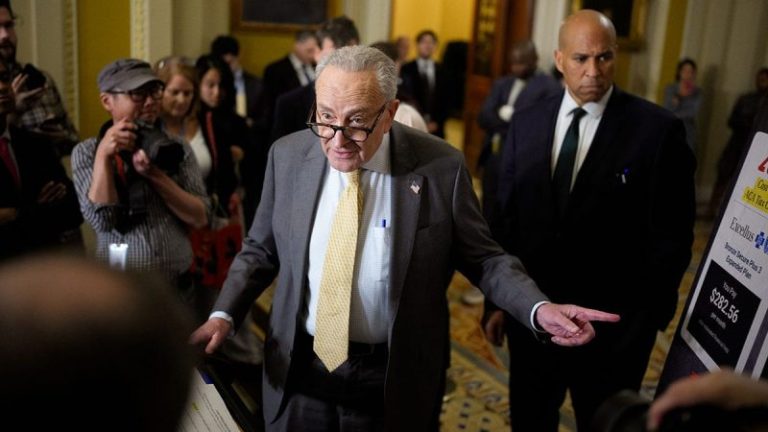
After an attempt to secure a bipartisan deal failed, Senate Republicans went nuclear for the fourth time in the Senate’s history Thursday to speed up confirmation of President Donald Trump’s nominees.

Republicans had threatened turning to the ‘nuclear option,’ which would allow for a rule change with a simple majority vote, to blast through the blockade from Senate Democrats and Senate Minority Leader Chuck Schumer, D-N.Y. 

Lawmakers were frustrated that, through the first eight months of Trump’s presidency, not a single nominee had moved through fast-track unanimous consent or voice votes.

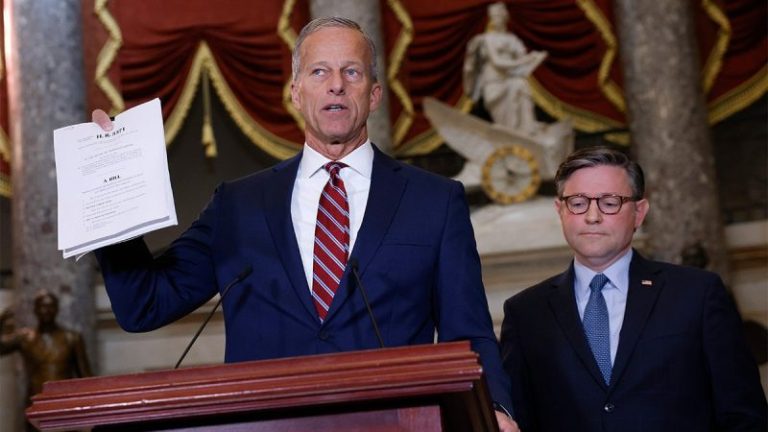
Senate Majority Leader John Thune, R-S.D., argued it shouldn’t have come as a surprise to Democrats what Republicans intended to do. 

‘I’ve been saying all week, ‘We’re going to vote on this on Thursday, one way or the other,” Thune said. 

‘We’re going to change this process in a way that gets us back to what every president prior has had when it comes to the way that these nominees are treated here in the United States Senate — by both sides, Republicans and Democrats; both presidents, Republicans and Democrats.’ 

The GOP’s rule change, which was born from a revived Democratic proposal from 2023, will now allow lawmakers to vote on Trump’s nominees in batches.

Senate Republicans’ rule change, which has been pitched as beneficial to the current and future administrations, would only apply to nominees subject to the Senate’s requirement for two hours of debate, which includes sub-Cabinet-level positions and executive branch picks.

Judicial nominees, like district court judges and district attorneys, don’t fall under the rule change. Lawmakers are expected to plow through dozens of nominees early next week under the new rules with the intent of clearing the backlog of Trump’s picks, which grew to more than 140 and counting. 

With the change in place, it will only take a simple majority vote to confirm the picks. Still, the decision to do bloc packages will require 30 hours of debate before a final confirmation vote. 

Schumer panned the move and contended Republicans had turned the Senate into ‘a conveyor belt for unqualified Trump nominees.’

‘This is a sad, regrettable day for the Senate, and I believe it won’t take very long for Republicans to wish they had not pushed the chamber further down this awful road,’ he said. 

However, before resorting to the nuclear option, lawmakers were close to a bipartisan deal that would have allowed for 15 nominees to be voted on in groups with two hours of debate.

Sen. Brian Schatz, D-Hawaii, blocked the new proposal on the floor and argued that Senate Republicans were trying to rush through the negotiating process ahead of their plan to leave Washington for the weekend.

‘What they’re asking for is unanimity, and we don’t have it,’ he said. ‘And, so, if you’re interested in enacting this on a bipartisan basis, the process for doing that — it is available to you. But, again, it’s more a matter of running out of patience than running out of time.’

A frustrated Thune fired back, ‘How much time is enough?

‘Give me a break,’ he said. ‘Two years. Not long enough. How about eight months? Eight months of this.’

The nuclear process began earlier this week when Thune teed up 48 nominees, all of which moved through committee on a bipartisan basis, for confirmation on the floor.

‘It’s time to move,’ Thune said. ‘Time to quit stalling. Time to vote. It’s time to fix this place. And the ideal way to fix it would be in a bipartisan way.’

Both parties have turned to the nuclear option a handful of times since 2010. In 2013, Senate Majority Leader Harry Reid, D-Nev., used the nuclear option to allow for all executive branch nominees to be confirmed by simple majority.

Four years later, Senate Majority Leader Mitch McConnell, R-Ky., went nuclear to allow for Supreme Court nominees to be confirmed by a simple majority. In 2019, McConnell reduced the debate time to two hours for civilian nominees.

This post appeared first on FOX NEWS

The fifth day of trial is slated to kick off in Fort Pierce, Florida on Friday for the case of Ryan Routh, who faces charges for attempting to assassinate President Donald Trump at his West Palm Beach golf club in September 2024.

On Thursday, then-Secret Service Special Agent Robert Fercano testified on behalf of the government that Routh pointed a rifle at his face while hiding out in shrubbery at the golf course. 

Fercano, currently assigned to Homeland Security Investigations, said he was scanning the sixth hole while Trump was playing the fifth when he ‘noticed several abnormalities on the fence line.’ 

‘There appeared to be a face, a barrel of a weapon and what I perceived to be plates, like Humvee plates like I saw in the Marine Corps,’ Fercano told Assistant U.S. Attorney Maria Medetis Long on Thursday. 

Fercano said that he initially thought he may have spotted a homeless person, but then noticed the barrel followed him and that the weapon was ‘pointed directly at my face.’ 

‘This appeared to be a textbook ambush scenario,’ Fercano said. 

Routh also questioned Fercano – and used his time to ask a series of questions regarding sniper tactics. 

‘As far as being a sniper, what would be the best stance to shoot people? Standing, crouching, laying down?’ Routh asked. 

‘I wasn’t a sniper … it depends,’ Fercano said. 

Others who testified Thursday included Tommy McGee, a government witness and a civilian who heard gunshots break out the day of the alleged assassination attempt and took a photo of Routh and his car. 

‘He looked frantic,’ McGee said Thursday. ‘He ran right in front of me. We looked at each other… it looked like he was trying to get away.’

When Justice Department prosecutor John Shipley asked McGee if Routh was the same man he saw the day of the alleged assassination attempt, McGee said yes. 

According to prosecutors, Routh laid out the groundwork to kill Trump for weeks, and hid out in shrubbery on Sept. 15, 2024, when a Secret Service agent, Fercano, identified him pointing a rifle at Trump while the then-presidential candidate played golf. Although Routh pointed his rifle at the agent, he then abandoned his weapon and the scene after Fercano opened fire.

Routh was later apprehended by the Martin County, Florida, Sheriff’s Office on the I-95 interstate in a black Nissan Xterra. 

According to the Justice Department, he is charged with attempted assassination of a major presidential candidate; possessing a firearm in furtherance of a crime of violence; assaulting a federal officer; felon in possession of a firearm and ammunition; and possession of a firearm with an obliterated serial number. Routh also faces state charges related to terrorism and attempted murder. 

Routh, who has pleaded not guilty to all charges, was previously convicted of felonies in North Carolina in 2002 and 2010. 

Routh, 59, is representing himself in his trial – a process known as ‘pro se.’ Routh sent a letter to U.S. District Judge Aileen Cannon in June notifying her of his decision to represent himself. 

‘I will be representing myself moving forward; it was ridiculous from the outset to consider a random stranger that knows nothing of who I am to speak for me,’ Routh said in the letter. ‘That was foolish and ignorant, and I am sorry-a childlike mistake.’ 

Cannon approved the move in July, although she said that she believes it’s not a good idea for Routh to represent himself in this case. Routh has said he went to college for two years after receiving a GED certificate and told Cannon he was prepared to navigate any challenges that could come from representing himself. 

Despite Routh’s decision to act singularly, court-appointed attorneys are still on call to provide standby counsel. 

Fox News’ Jamie Joseph, Jake Gibson, Olivianna Calmes, Heather Lacey and The Associated Press contributed to this report.

This post appeared first on FOX NEWS

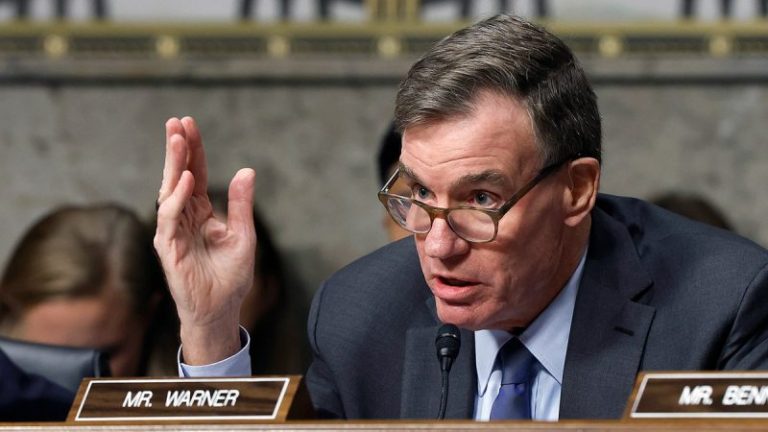
Last-minute closed-door talks between Senate Republicans and Democrats failed to prevent a ‘nuclear option’ in the upper chamber, as frustrations on both sides killed a deal to move ahead with President Donald Trump’s nominees.  

Lawmakers were inching closer to a deal that would have allowed sub-Cabinet-level nominees to be voted on in bunches, but neither side could reach a final agreement.

Senate Republicans argued that a majority of their counterparts agreed with the new proposal, but that Senate Minority Leader Chuck Schumer, D-N.Y., was still standing in the way.

‘I think the majority of Democrats are on board with it,’ Sen. James Lankford, R-Okla., told Fox News Digital. ‘And Schumer is blocking it from actually having consent to come to the floor.’

The failed deal was a modified version of a proposal first unveiled by Senate Democrats in 2023, and would have allowed 15 nominees to be batched together en bloc and voted on while still requiring two hours of debate for the group.

But when Lankford brought the proposal to the floor for consideration, Sen. Brian Schatz, D-Hawaii, blocked it.

Schatz argued that Senate Republicans were trying to rush through the negotiating process ahead of their plan to leave Washington for the weekend.

‘What they’re asking for is unanimity, and we don’t have it,’ he said. ‘And so, if you’re interested in enacting this on a bipartisan basis, the process for doing that — It is available to you. But again, it’s more a matter of running out of patience than running out of time.’

Senate Majority Leader John Thune, R-S.D., fired back ‘how much time is enough?’

‘Give me a break,’ he said. ‘Two years. Not long enough. How about eight months? Eight months of this.’

With the prospects of bipartisan deal to move nominees through Democrats’ blockade, Senate Republicans are expected to continue down the path of the ‘nuclear option.’

That means that their initial proposal, which would allow for an unlimited number of sub-cabinet level nominees to be voted on en bloc with 30 hours of debate tacked on, is expected to pass with a simple majority, and effectively change the confirmation process in the Senate.

‘We are achingly close to doing this like adults,’ Schatz said.

This post appeared first on FOX NEWS

/ NOT INTENDED FOR DISTRIBUTION TO UNITED STATES NEWS WIRE SERVICES OR FOR DISSEMINATION IN THE UNITED STATES /

Heritage Mining Ltd. (CSE: HML) (FRA: Y66 ) (‘ Heritage ‘ or the ‘ Company ‘) is pleased to announce an exploration update on Zone 3 Extension Mega-Quartz Vein System at its Flagship Drayton-Black Lake Project (‘DBL’). Which has confirmed broad gold zone within a newly discovered ~74m wide quartz vein system (true width unknown) associated with a magnetic anomaly that extends for ~4km along strike length and is up to 200m in width (Figure 2) at its flagship Drayton Black Lake Project September 9, 2025 press release.

DBL Exploration Program Highlights:

  • Aggressive Soil/Till Orientation Survey (Figure 1) over Zone 3 Extension Area
  • Follow-up Soil/Till Survey – success based on Orientation Survey (Figure 1) expected Q4 2025
  • Outcrop/Vein stripping permit received above HML25-013 (Figure 2)
  • Initiate a structural Study of the Mega-Quartz Vein System (Figure 2)
  • Diamond Drilling Q4, 2025/Q1 2026 (Figure 3)

‘We are eager to further explore the newly discovered Zone 3 Extension Mega-Quartz Vein Structure systematically. Our team has developed a comprehensive approach to further exploring this area as well as broader exploration programs before winter. I would like to thank the exploration team for their strong efforts in the discovery of a such wide vein system.’ Commented Peter Schloo , President, CEO and Director of Heritage Mining Ltd.

Discussion of Exploration Program

Soil/Till Program

The purpose of the soil and till program is to Rapidly evaluation the newly identified Zone 3 Extension – Mega Quartz Vein Structure as well as a broader evaluation of Alcona , Zone 10, Zone 3, and New Millennium with a terrain-aware B-horizon program. Bias sampling toward stable, well-drained eluvial–illuvial positions where podzolic Bf/Bh horizons preserve pathfinder chemistry. Soil/till program will be solidified following an orientation survey of key areas. The outcome of this program is to identify Pathfinders for each target defined and identify near surface mineralization footprint across target areas.

Stripping and Structural Evaluation

The Company has received a stripping permit for the area above HML25-013 along the newly identified Zone 3 Extension – Mega Quartz Vein Structure. Stripping this area with follow on sampling and structural evaluations are planned for the Company’s 2025 Exploration program at DBL. The result of this program is to further evaluate the structural discovery at surface to better prioritize further targeting methods.

Scout Diamond Drilling

Additional scout diamond drilling is planned for the 2025 exploration program at the newly identified Zone 3 Extension – Mega Quartz Vein Structure. Following the completion of Soil/Till Program and Stripping and Structural Evaluation the Company intends to commence scout drilling with additional data. The Company may initiate the scout drilling program earlier depending on additional internal evaluation.

Conclusion

The discovery of a broad gold zone in the the newly identified Zone 3 Extension – Mega Quartz Vein Structure warrants additional systemic exploration to further develop our discovery model.

Qualified Person

Stephen Hughes P. Geo , Strategic Advisor for the Company, serves as a qualified person as defined by National Instrument 43-101 – Standards of Disclosure for Mineral Projects and has reviewed the scientific and technical information in this news release, approving the disclosure herein.

Technical Program

Heritage Mining adheres to a strict QA/QC protocol for handling, sampling, sample transportation and analyses.  Chain-of-custody protocols are designed to ensure security of samples until their delivery at the laboratory.

Sampling, Sub-sampling, and Laboratory Analysis for Heritage Mining Drayton Black Lake Project All drilling at the Drayton Black Lake project recovers NQ core. Drill core is systematically split in half using a diamond saw. A qualified geologist examines the drill core, marking intervals for sampling and indicating the cutting line. Sample lengths are typically 1.0 metre, adjusted to a minimum length of 0.5 metre as necessary to respect lithological and/or mineralogical contacts and to isolate narrow veins or structures that may contain higher-grade mineralization.

Technicians saw the core along the cutting lines determined by the geologist. One half of the core is retained as a witness sample, while the other half is submitted for analysis. Individual sample bags are securely sealed and placed into sealed bags, which are then clearly marked with their contents.

Heritage Mining submits samples for gold determination by PhotonAssay to ALS Canada Ltd. (‘ ALS ‘). ALS operates under a commercial contract with Heritage Mining.

Drill core samples are shipped to ALS for sample preparation at their facilities in Thunderbay Ontario. ALS is an ISO/IEC 17025:2017 accredited laboratory for the PhotonAssay method in addition to a variety of diverse metal determination methods.

Analytical Procedures

The ALS procedure for PhotonAssay involves lab applying preparation codes LOG-21 (sample logging via barcode), CRU-31 (fine crushing so that 70% passes through a 2mm screen) and SPL-32a (rotary splitting of a representative ~500g subsample)  followed by analytical code Au-PA01 which is a non-destructive gold analysis method using high-energy X-rays with a gold detection range from 0.03 ppm to 350ppm.

After gold assays are returned, Heritage then may choose to perform multi-element assays on selected samples based on the gold results. In these cases, sample preparation codes FND-05 (locate and use remaining crushed material from Au-PA01) and PUL-32m (pulverization so that >85% passes 75 µm screen) are then applied followed by analytical code ME-MS61 (multi-element ICP-MS analysis for base metals, pathfinder elements, lithophile elements and rare earth elements).

________________________________________
Quality Assurance/Quality Control (QA/QC)

The drill program design, QA/QC, and interpretation of results are performed by qualified persons employing a rigorous QA/QC program consistent with industry best practices. Standards and blanks account for a minimum of 10% of the samples, in addition to the laboratories’ internal quality assurance programs.

Quality Control data are meticulously evaluated upon receipt from the laboratories for any failures. Appropriate corrective action is taken if assay results for standards and blanks fall outside allowed tolerances. All results disclosed by Heritage Mining have successfully passed the Company’s stringent quality control protocols.

The Company does not recognize any factors of drilling, sampling, or recovery that could materially affect the accuracy or reliability of the assay data disclosed. The assay data disclosed in this press release have been verified by the Company’s Qualified Person against the original assay certificates.

Heritage Mining notes that it has not completed any economic evaluations of its Drayton-Black Lake Project, and the project does not currently have any resources or reserves.

ABOUT HERITAGE MINING LTD.

The Company is a Canadian mineral exploration company advancing its two high grade gold-silver-copper projects in Northwestern Ontario . The Drayton Black Lake and the Contact Bay projects are located near Sioux Lookout in the underexplored Eagle-Wabigoon-Manitou Greenstone Belt. Both projects benefit from a wealth of historic data, excellent site access and logistical support from the local community.

FORWARD-LOOKING STATEMENTS

This news release contains certain statements that constitute forward looking information within the meaning of applicable securities laws. These statements relate to future events of the Company. Any statements that express or involve discussions with respect to predictions, expectations, beliefs, plans, projections, objectives, assumptions or future events or performance (often, but not always, using words or phrases such as ‘seek’, ‘anticipate’, ‘plan’, ‘continue’, ‘estimate’, ‘expect’, ‘forecast’, ‘may’, ‘will’, ‘project’, ‘predict’, ‘potential’, ‘targeting’, ‘intend’, ‘could’, ‘might’, ‘should’, ‘believe’, ‘outlook’ and similar expressions are not statements of historical fact and may be forward looking information. All statements, other than statements of historical fact, included herein are forward-looking statements.

Forward looking information involves known and unknown risks, uncertainties and other factors which may cause the actual results, performance, or achievements of the Company to be materially different from any future results, performance or achievements expressed or implied by the forward-looking information. Such risks include, among others, the inherent risk of the mining industry; adverse economic and market developments; the risk that the Company will not be successful in completing additional acquisitions; risks relating to the estimation of mineral resources; the possibility that the Company’s estimated burn rate may be higher than anticipated; risks of unexpected cost increases; risks of labour shortages; risks relating to exploration and development activities; risks relating to future prices of mineral resources; risks related to work site accidents, risks related to geological uncertainties and variations; risks related to government and community support of the Company’s projects; risks related to global pandemics and other risks related to the mining industry. The Company believes that the expectations reflected in such forward-looking information are reasonable, but no assurance can be given that these expectations will prove to be correct and such forward‐looking information should not be unduly relied upon. These statements speak only as of the date of this news release. The Company does not intend, and does not assume any obligation, to update any forward‐looking information except as required by law.

This document does not constitute an offer to sell, or a solicitation of an offer to buy, securities of the Company in Canada , the United States , or any other jurisdiction. Any such offer to sell or solicitation of an offer to buy the securities described herein will be made only pursuant to subscription documentation between the Company and prospective purchasers. Any such offering will be made in reliance upon exemptions from the prospectus and registration requirements under applicable securities laws, pursuant to a subscription agreement to be entered into by the Company and prospective investors.

SOURCE Heritage Mining Ltd.

View original content to download multimedia: http://www.newswire.ca/en/releases/archive/September2025/11/c1327.html

News Provided by Canada Newswire via QuoteMedia

This post appeared first on investingnews.com

Mart Wolbert, analyst at Contrarian Codex, is seeing a uranium mindset shift as more investors take stock of the growing supply/demand imbalance in the market.

He explains how he’s approaching uranium stocks and shares his price outlook.

Securities Disclosure: I, Charlotte McLeod, hold no direct investment interest in any company mentioned in this article.

This post appeared first on investingnews.com